Nutritional and taste quality of harvests
The primary criterion for the selection of natural seeds
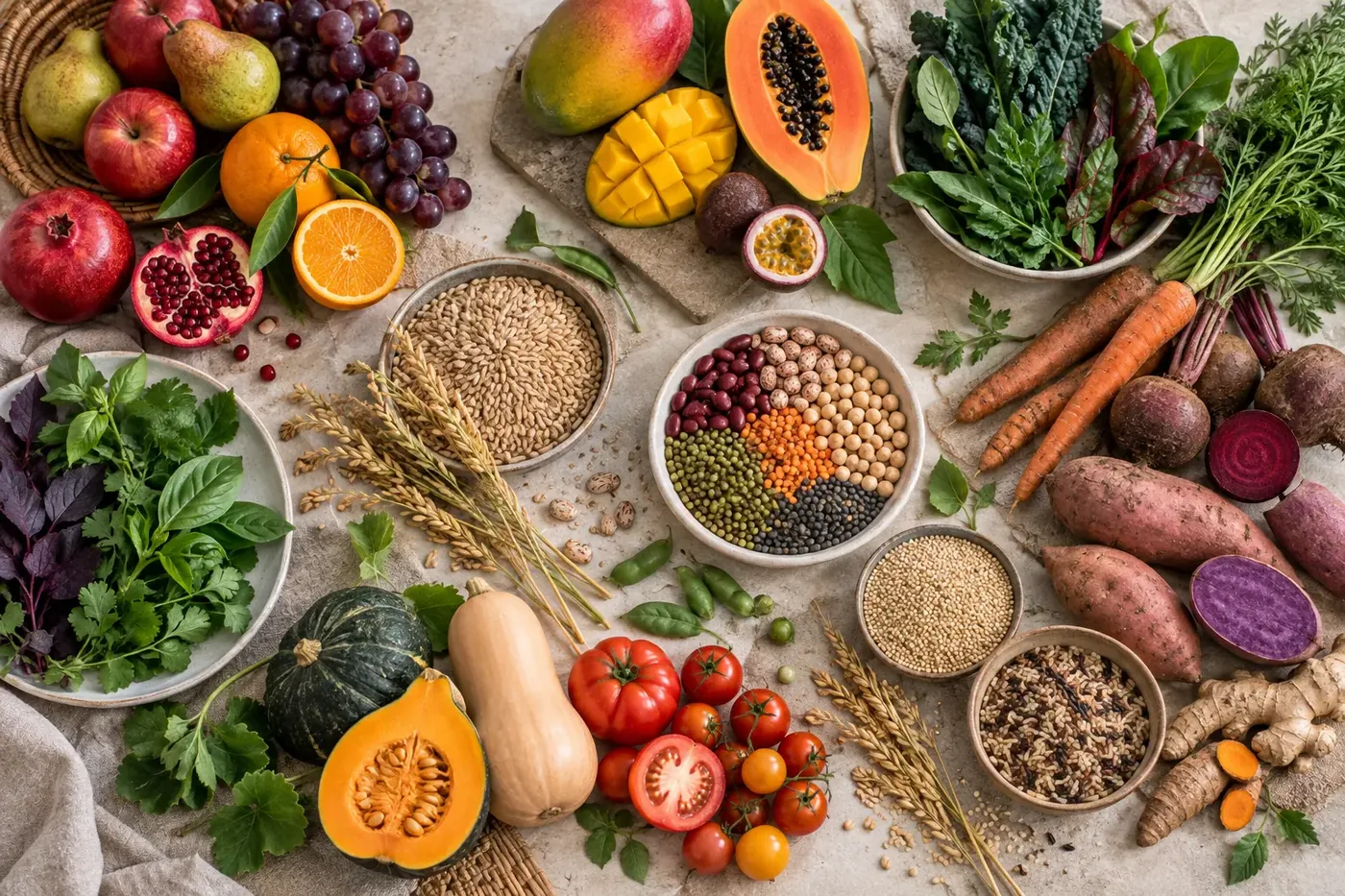
The quality targeted concerns the harvests themselves: fruits, leaves, roots, tubers, grains and other edible parts produced. It does not primarily concern recipes or culinary transformation.
What is evaluated
The evaluation concerns the part actually consumed of a plant cultivated in a given territory, at a specified harvest stage, under described conditions.
- Fruits, leaves, roots, tubers, grains and other edible parts produced.
- Harvest stage, growing conditions, soil, water, climate and season.
- Seed traceability: provenance, varietal identity, reproducibility.
Cooking and transformation come afterward. They can reveal a quality; they do not produce it.
Order of criteria
| Rank | Criterion | What it requires |
|---|---|---|
| 1 | Nutritional quality | The actual food contribution of the harvest, established by analysis before any strong claim. |
| 2 | Taste quality | The taste of the harvest, assessed in a described and comparable context. |
| 3 | Natural, reproducible seed | A natural seed, resown and multiplied without a purchase imposed at each cycle. |
| 4 | Territorial adaptation | Behavior observed under local conditions, over several seasons. |
| 5 | Local reproduction | The capacity to produce true-to-type and viable seeds on site. |
| 6 | Genetic and food diversity | The widening of a territory's food resources, without uniformization. |
| 7 | Ecological and territorial consequences | Effects on soils, water, present species and the territory's balances. |
Scroll the table horizontally.
Yield, size, appearance and aptitude for commercial storage demonstrate no nutritional or taste quality.
Ten-step evaluation protocol
- Documented preselection: inventory of candidates and sources consulted.
- Botanical, varietal and geographic identity: precisely naming what is being studied.
- Provenance and reproducibility: verifying the origin and reproducible nature of the seed.
- Comparative cultivation: growing several candidates under described and comparable conditions.
- Observation of the harvest: parts produced, quantities, regularity, defects observed.
- Contextualized tasting: taste assessed at the specified stage and under the specified conditions.
- Nutritional analysis before any strong claim: no claim without measurement.
- Reproduction over several cycles: verifying the stability of observations over time.
- Publication of limitations: uncertainties, failures, biases and scope of validity.
- Decision: continue, correct or abandon, with a written reason.
This protocol describes a method to be applied. No step has yet been carried out: no data, no result and no experiment are presented.
What it is forbidden to claim
No harvest is declared "better", "more nutritious" or "adapted" without an established comparison, a described method, a specified territory and an indicated level of proof.
- No superlative without a named comparison.
- No nutritional claim without analysis.
- No claim of adaptation without several seasons observed.
- No result announced before having been produced and published with its limitations.