
EDIBLE FOREST SEEDS
Central operational programme to be prepared
EDIBLE FOREST SEEDS is the programme devoted to natural seeds: research, provenance, responsible acquisition, future experimentation, quality of harvests, acclimatization, local reproduction and transmission. It is not yet operational.
Public status
| Element | Nature | Operational status |
|---|---|---|
| EDIBLE FOREST SEEDS conceptual heritage | Historical reference | Existing |
| Future EDIBLE FOREST SEEDS programme | Future central programme | In preparation |
| Territorial structure and activity | Future material forms | Not constituted |
Scroll the table horizontally.
“Historical reference” describes the nature of the element and not its operational status. The four operational statuses used on this site are: Existing, In preparation, Envisaged, Not constituted.
An element that can be verified as presently real.
Work has actually begun, without implying that the final form, resources or timetable are established.
A possible future direction that is not yet being implemented.
No operational structure, activity or verified reality currently exists.
No seed held, no batch, no stock, no network, no partner, no funding, no experiment underway and no result are presented.
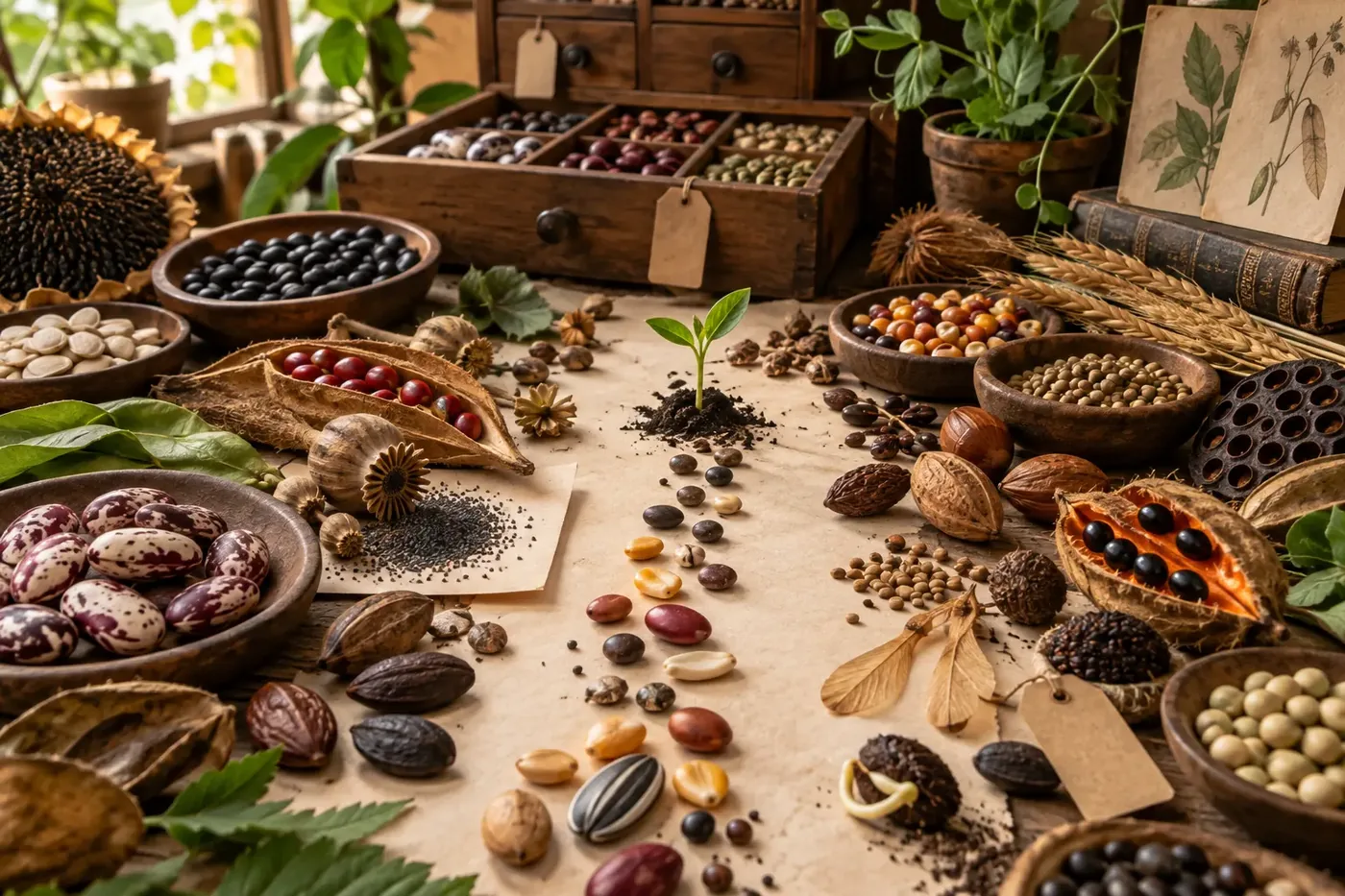
Mission of the programme
- Search, worldwide, for natural, reproducible seeds.
- Establish the provenance and identity of each seed studied.
- Organize responsible acquisition, respectful of people and territories of origin.
- Prepare an experiment in Gabon, envisaged as a first pilot.
- Evaluate the nutritional and taste quality of the harvests obtained.
- Observe acclimatization under local conditions, over several seasons.
- Produce reproducible seed locally.
- Transmit seeds, methods, observations and limitations.
- Envisage Liberia as a second stage, then other African territories.
Explicit exclusions
- Hybrid seeds.
- Genetically modified seeds.
- Sterile or non-reproducible seeds.
- Any system requiring systematic repurchase for every cycle.
- Introduction of a species without ecological risk assessment.
- Claims of quality, adaptation or result without evidence.
- Appropriation of a living resource or of local knowledge.
Planned documentation tools
These tools describe what the programme will have to maintain. They are presented empty: no data exists to date.
Provenance and variety record
Origin, botanical and varietal identity, conditions of acquisition.
Batch register
Identification, quantity, year, traceability of a seed batch.
Germination monitoring
Rate, conditions, duration, observed anomalies.
Cultivation journal
Soil, water, associations, care, incidents, season.
Harvest observation
Parts produced, quantities, regularity, defects.
Tasting
Stage, conditions, comparisons, contextualized assessments.
Nutritional analysis
Measurements, method, laboratory, scope of validity.
Reproduction cycles
Trueness to type, viability, stability over several generations.
Status and corrections
Continued, corrected, abandoned; incidents and reasoned decisions.
Field references
Le Potager de Santé — Pascal & Rachel Poot
In Olmet-et-Villecun, in the Hérault department of France, Pascal and Rachel Poot produce organic vegetable seeds. According to their own presentation, they have spent more than twenty years selecting heritage varieties and populations adapted to difficult conditions, including drought, excess moisture and disease.
Their approach gives an important place to reproducible seeds, local adaptation, observation of living systems and the transmission of practices.
Their experience is an independent field reference particularly relevant to EDIBLE FOREST SEEDS, especially when considering seed reproducibility, gradual adaptation to local environments and the pursuit of greater food autonomy.
This independent reference does not constitute a partnership, support for EF-OUA, ongoing collaboration, a joint programme or an official relationship. It does not demonstrate the adaptation of these seeds to other territories: this will need to be evaluated under local conditions.