
EDIBLE FOREST
Organization of African Unity — through conscientization
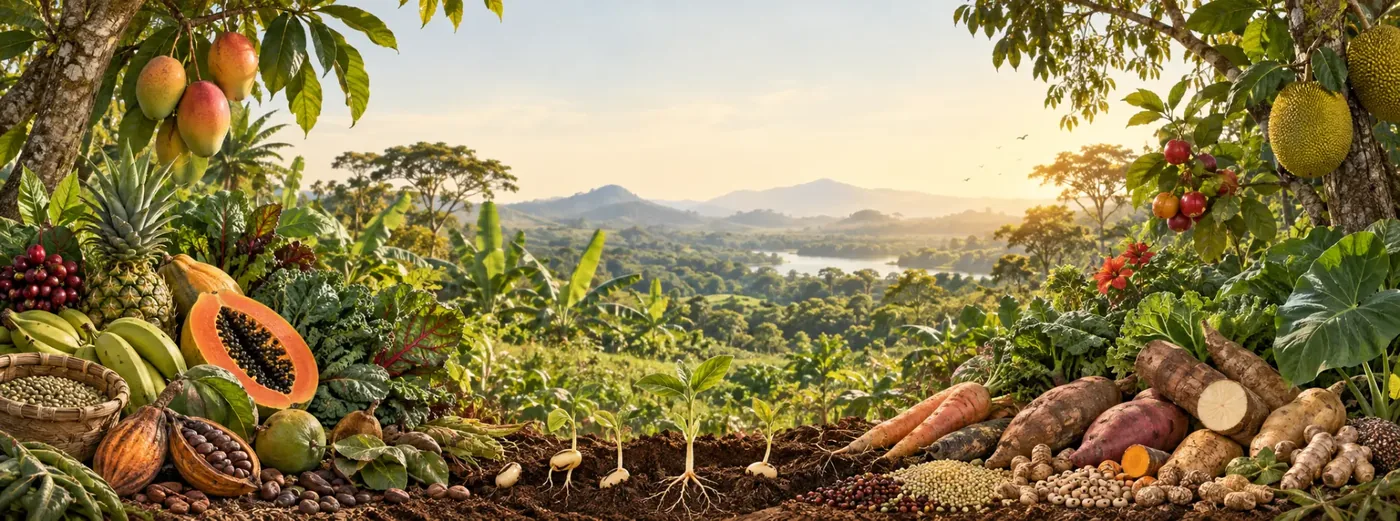
EDIBLE FOREST begins with the possibility of enriching African territories through the identification, selection, acclimatization, reproduction and transmission of natural edible resources—particularly reproducible seeds and plants—chosen for the nutritional and taste quality of the harvests they can produce.
The project is carried by an association loi 1901 (French non-profit association) created in 2014 (RNA W542001352, SIREN 803 052 711). Its current name, governance and registered office in Brive-la-Gaillarde were declared on 6 September 2026 and officially registered. Territorial developments remain in preparation or envisaged and will be documented as they are implemented.
The fundamental principle
EDIBLE FOREST concerns the quality and diversity of edible resources that can be cultivated, reproduced and transmitted.
An edible resource is considered for what it truly brings to the person who consumes it: its nutritional value and its taste quality. A resource only becomes durably useful if it can be cultivated, reproduced locally and transmitted to other people and other territories.
Quality is not to be confused with yield, size, appearance or commercial shelf life. A high volume or a uniform fruit does not prove the nutritional or taste quality of a harvest.
Quality
Nutritional value and taste quality of the edible parts actually harvested.
Diversity
Plurality of species, varieties, strata and harvest periods, against dependence on a single crop.
Reproducibility
Natural seeds, reproducible locally, without mandatory repurchase each cycle.
Why begin with seeds
The seed is the most consequential starting point, because it holds the entire possibility: provenance, plant, harvest, adaptation to the territory, multiplication and transmission.
- Provenance: where the seed comes from, which variety, under what original conditions.
- Harvest: which edible parts it produces, and with what quality.
- Adaptation: what it becomes in a given soil, climate and cultivation practice.
- Multiplication: its capacity to reproduce on site, cycle after cycle.
- Transmission: its circulation to other growers and other territories.
The seed is not treated as an isolated commercial object. It is a link in a chain of consequences that begins before purchase and continues long after the first harvest.
From selection to transmission
The approach envisaged follows a precise sequence. Each step produces documented observations and may lead to correcting or abandoning a path.
- Worldwide selection: seeking natural seeds in the regions and cultures that produce them.
- Identification: establishing botanical, varietal and geographical identity.
- Comparative cultivation: growing under comparable, observable conditions.
- Harvest: observing the edible parts actually produced.
- Acclimatization: assessing behavior in the host territory.
- Local reproduction: verifying reproducibility over several cycles.
- Conservation: preserving reproduced seeds under traceable conditions.
- Transmission: transmitting seeds, methods, limits and uncertainties.
EDIBLE FOREST SEEDS
Status: In preparation. Territorial structure and activity are not constituted.
EDIBLE FOREST SEEDS is the central operational program to be prepared: worldwide seed research, provenance verification, responsible acquisition, territorial experimentation, observation of harvest quality, acclimatization, local reproduction and transmission.
At this stage, no constituted structure, no territorial activity, no stock and no catalog is presented. What is published describes a mission to be prepared, not an activity under way.
From Gabon to Africa
| Territory | Envisaged role | Public status |
|---|---|---|
| Gabon | First pilot territory envisaged for initial experimentation | Envisaged |
| Liberia | Second step envisaged after producing transmissible knowledge | Envisaged |
| Other African territories | Progressive extension of the method, adapted locally | Envisaged |
Scroll the table horizontally.
The method cannot be transposed as is. Each territory has its own soils, climates, languages, practices, resources and responsibilities. What could circulate is a method of observation and transmissible knowledge, not a uniform model.
No current establishment, no land acquired, no constituted territorial network.
Why an Organization of African Unity
Durably enriching nourishing territories exceeds what an isolated initiative can carry. Such an ambition requires coordination between territories: sharing methods, comparing observations, circulating reproduced seeds and transmitting knowledge.
This coordination assumes neither centralization of decisions, nor uniformization of territories, nor ownership of local resources. Each territory retains responsibility for its resources, its decisions and the local consequences of any experimentation.
The Organization organizes the African ambition of EDIBLE FOREST. It is not the origin of EDIBLE FOREST.
The conscious foundation
The way of thinking and acting follows an order: Intelligence → Savoir → Conscientization → consequence-aware Organization.
An instantaneous, non-memory-based relationship with reality, which orders it and makes it expressible.
New information that proceeds from Intelligence, distinct from memory and the accumulation of knowledge.
Recognition of what, in thought and action, proceeds from memory, the ego or collective consciousness, so that the known does not govern the present on its own.
Translation of this consciousness into functions, responsibilities and actions that are controllable and correctable.
This chain governs the way of acting. EDIBLE FOREST remains the purpose and the material orientation of the project.
Origins and continuity
EDIBLE FOREST has its own origin: a proposal concerning seeds, harvests and nourishing territories, from which EDIBLE FOREST SEEDS emerged and whose African ambition led to the need for an organization.
This origin is not to be confused with the founding impulse that led to the creation of the OAU in Addis Ababa in 1963. The Organization recognizes the conscious continuity of that impulse, without claiming any legal succession from the former OAU.
Actual status and participation
What exists: the proposal, the conceptual framework, the Public Constitution and the public website. What is in preparation: EDIBLE FOREST SEEDS and the organization's operating arrangements. What is envisaged: the Gabonese pilot, then Liberia, then other African territories.
What does not exist: an operational seed bank, a constituted territorial network, a partnership, funding, ongoing experimentation or a validated result.
Participation concerns only real and identifiable contributions: research, verifiable skill, study, fieldwork, documentation of an experience or support for a precisely defined action.