
EDIBLE FOREST
Foundational proposition of the EDIBLE FOREST Organization of African Unity
EDIBLE FOREST begins with the possibility of enriching African territories through the identification, selection, acclimatization, reproduction and transmission of natural edible resources—particularly reproducible seeds and plants—chosen for the nutritional and taste quality of the harvests they can produce.
The meaning of the name
The nutritional and taste quality of the resource produced. The word designates what is actually eaten and what it provides, not a merely theoretical edibility.
A nourishing territory progressively enriched with diverse edible resources. An actual edible forest is one possible form of this territory, not its sole destination.
EDIBLE FOREST does not therefore designate a single agronomic model. It designates an orientation: increasing, within a territory, the diversity and quality of food resources that can be cultivated, reproduced and transmitted.
Four things not to confuse
EDIBLE FOREST
The foundational proposition and the purpose: the quality and diversity of a territory's food resources.
An edible forest
One concrete form of vegetal arrangement among others, possible but not mandatory.
EDIBLE FOREST SEEDS
The central operational program to be prepared, devoted to natural seeds, their experimentation and their transmission.
The Organization
The EDIBLE FOREST Organization of African Unity, which organizes the African ambition of this proposition.
An external forest-garden example
An edible forest or forest garden is one possible material form of a nourishing territory, but it does not encompass EDIBLE FOREST as a whole. To explore a concrete and independent forest-garden example in France, discover the work of La Forêt Gourmande.
Independent external resource. No partnership, institutional affiliation or participation in the EDIBLE FOREST project is claimed.
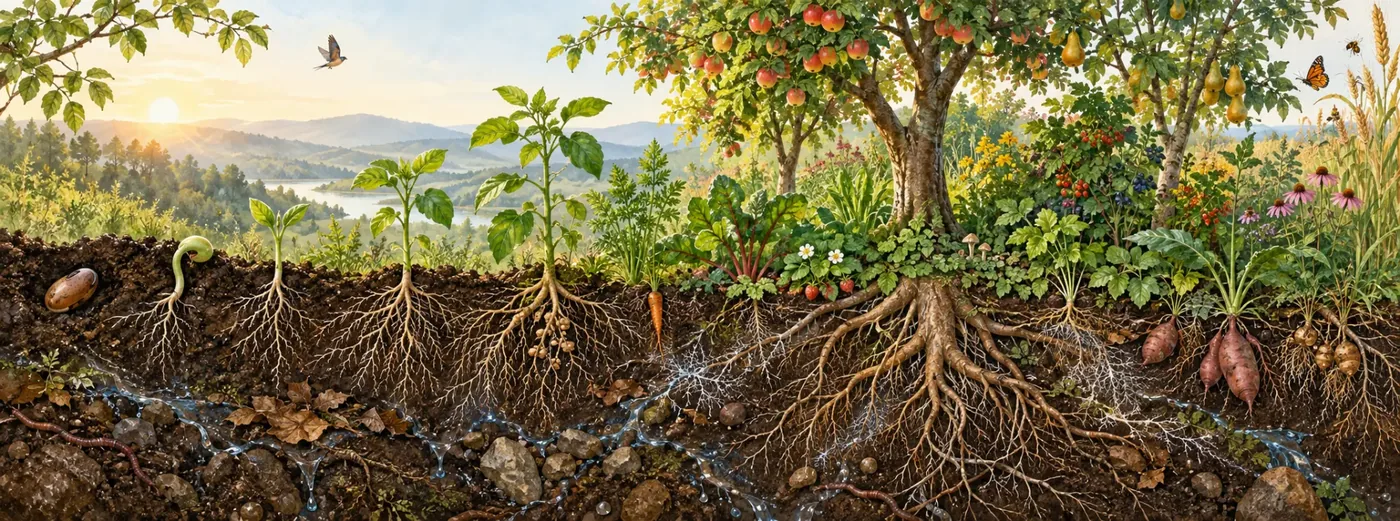
Seeds, plants, harvests, soils, water, associations
A harvest never depends on the seed alone. It depends on the plant, the soil, the water, the climate, plant associations, the care provided and time.
- Seeds: provenance, varietal identity, reproducibility.
- Plants: behavior, vigor, cycle, sensitivity.
- Harvests: fruits, leaves, roots, tubers, grains and other edible parts produced.
- Soils: structure, fertility, soil life, observed evolution.
- Water: availability, seasonality, consequences of withdrawals.
- Plant associations: strata, shading, complementarities and competition.
Living matter constitutes a field of observation and consequence, not inert material or a backdrop. Every action there produces effects that go beyond the immediate result sought.
A territorial capacity to build
A nourishing territory is not a place that receives seeds. It is a place that becomes capable of keeping them alive.
- Germinate: obtain a reliable and observed emergence.
- Cultivate: carry the plant through to an actual harvest.
- Acclimatize: observe behavior under local conditions, over several seasons.
- Reproduce: produce reproducible seeds on site.
- Transmit: share seeds, methods, observations and limitations.
This capacity is built progressively. It cannot be claimed before having been observed and documented in the territory concerned.
Gabon, Liberia, Africa
| Territory | Role | Public status |
|---|---|---|
| Gabon | First envisaged pilot | Envisaged |
| Liberia | Envisaged second stage | Envisaged |
| Africa | Progressive widening after the production of transmissible knowledge | Envisaged |
Scroll the table horizontally.
No current establishment, network, partner, funding, ongoing experiment or result is presented.
What this page does not claim
No harvest is declared better, more nutritious or adapted without an established comparison, a described method, a specified territory and an indicated level of proof.